In 2023, a viral image of an explosion near the Pentagon briefly sent financial markets tumbling before it was identified as AI-generated. No explosion had occurred. The image was entirely fabricated, but for several minutes, it was treated as breaking news by some outlets and widely shared on social media.
This incident captured the central challenge AI poses to journalism: in an environment where speed matters and visual evidence drives coverage, AI-generated images can inject fabricated "evidence" into the news cycle faster than verification processes can catch it.
The Growing Threat to News Credibility
AI-generated misinformation in news contexts has grown sharply in 2024 and 2025. Notable examples include fabricated images of natural disasters used to drive fraudulent donation campaigns, AI-generated photos of political figures in compromising situations circulated during election seasons, deepfake video clips of world leaders making inflammatory statements, and fake "eyewitness" images of events that never happened.
The speed at which these images spread (often reaching millions of people before debunking) means that corrections rarely undo the initial impact. First impressions, especially visual ones, are remarkably sticky.
Challenges for Newsrooms
Journalists and editors face an unprecedented verification burden:
- Speed vs. accuracy: Breaking news demands rapid response, but verifying whether images are authentic takes time. The pressure to be first often conflicts with the need to be right.
- Volume: Social media generates an enormous volume of user-submitted images during news events. Identifying which are genuine eyewitness photos and which are AI-generated or manipulated is a massive filtering challenge.
- Sophistication: Current AI-generated images can be good enough to fool experienced photo editors, especially at the resolutions used in online news. The visual tells that once made AI images easy to spot are becoming subtler.
- Source verification: Traditional verification relies on tracing an image back to its original source. AI-generated images have no original source beyond the generator, making standard provenance checks less effective.
Ethical Frameworks Emerging
Major news organizations and journalism associations have responded by developing policies for AI use:
- Transparency policies: Organizations like the Associated Press and Reuters have established guidelines requiring disclosure when AI tools are used in content creation. Most prohibit using AI-generated images as photographic evidence.
- Verification protocols: Newsrooms are investing in image verification workflows that include AI detection as a standard step alongside traditional methods like reverse image search and metadata analysis.
- Editorial standards: Many publications have drawn a clear line: AI-generated images may be used for illustration (clearly labeled) but never presented as documentary photography.
- Industry collaboration: Initiatives like the Content Authenticity Initiative (CAI) and the C2PA standard are creating technical infrastructure for verifying the provenance of digital media.
The Wider Impact on Public Trust
The effects extend beyond individual fake images. Research shows that as people become aware that AI can generate convincing fake imagery, their trust in all news imagery decreases, including authentic photos. This creates a paradox: greater awareness of AI fakes leads to greater skepticism of real evidence.
This trust deficit has real consequences. When authentic documentation of atrocities, natural disasters, or political events can be dismissed as "probably AI," the evidentiary power of photojournalism, which has historically played a crucial role in driving public awareness and accountability, is diminished.
What Consumers Can Do
As a news consumer, you can protect yourself from AI-generated misinformation:
- Check the source. Is the image from a credible news organization with editorial standards, or was it shared anonymously on social media?
- Look for corroboration. Major events produce multiple images from multiple sources. A single dramatic image with no corroborating visual evidence warrants skepticism.
- Examine the image critically. Apply the same techniques used to distinguish AI from real images: zoom in, check for artifacts, look at text and background details.
- Wait before sharing. The most impactful misinformation spreads in the first minutes and hours. Waiting even a short time for verification can prevent you from amplifying false content.
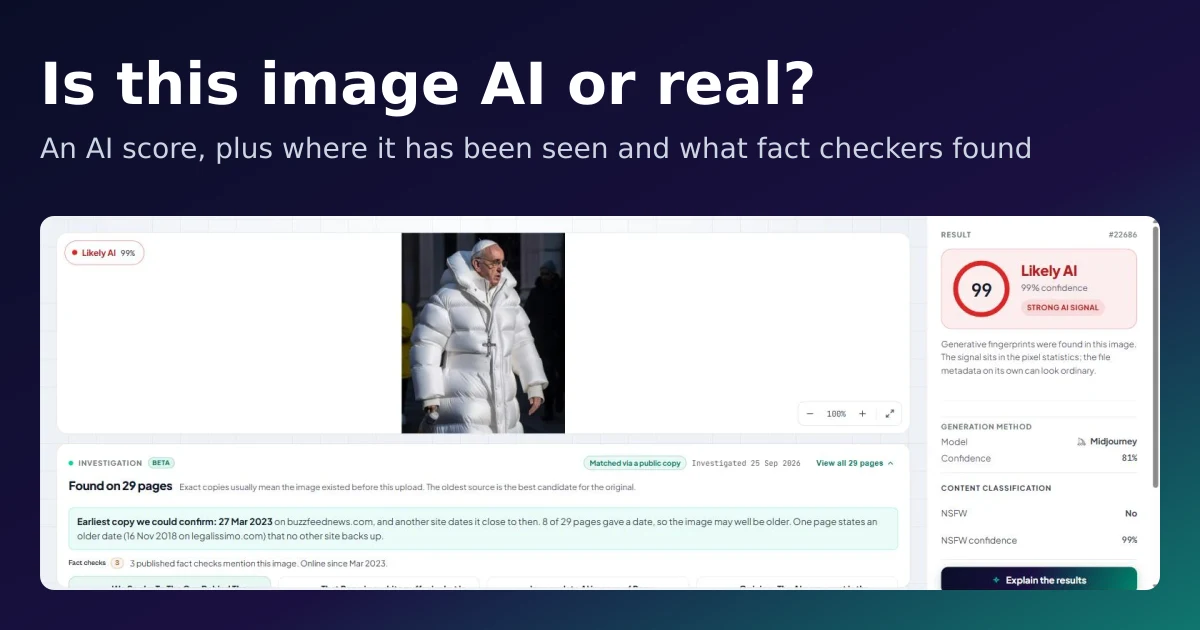
- Use detection tools. When an image seems too dramatic or too perfectly composed for a breaking news situation, running it through an AI image detector adds an objective data point to your assessment.
The relationship between AI and journalism is still being defined. What's clear is that maintaining an informed, trustworthy press in the age of synthetic media requires effort from newsrooms, technology platforms, and audiences alike.