In September 2022, an image called Théâtre D'Opéra Spatial won first place in the digital art category at the Colorado State Fair. The catch? It was created using Midjourney, an AI image generator. The backlash was immediate and fierce: artists called it the death of creative integrity while others saw it as the dawn of a new artistic era.
That moment crystallized a transformation that had been building for years. AI art has gone from a niche curiosity to a cultural force that is reshaping how we think about creativity, authorship, and the value of human expression.
A Brief History of AI Art
The roots of AI-generated art stretch back further than most people realize. In 2015, Google's DeepDream created surreal, psychedelic images by amplifying patterns in neural networks. The results were more novelty than art, but they demonstrated that machines could produce visually interesting output.
The real leap came with Generative Adversarial Networks (GANs), introduced by Ian Goodfellow in 2014. GANs pit two neural networks against each other: one generates images while the other tries to detect fakes. Through this adversarial process, generators steadily improved. By 2018, the AI-created portrait Edmond de Belamy sold at Christie's for $432,500.
But GANs had limitations: they produced relatively low-resolution images and struggled with complex compositions. The breakthrough came with diffusion models in 2021-2022. These models work by learning to reverse a noise-adding process, starting from random static and progressively refining it into a coherent image. The results were dramatically better than anything GANs could produce.
The Tools Shaping AI Art Today
Several platforms have made AI art accessible to anyone with a text prompt:
- Midjourney: Known for its painterly, atmospheric aesthetic. Popular among digital artists and designers for concept art and illustration.
- DALL-E (OpenAI): Excels at following complex, specific prompts and has strong text rendering capabilities in its latest versions.
- Stable Diffusion: An open-source model that users can run locally, customize, and fine-tune. Its openness has spawned a massive community of developers creating specialized models.
- Flux: A newer entrant offering high-quality generation with improved coherence and photorealism.
These tools have evolved from producing obviously artificial images to generating content that can be difficult to distinguish from photographs.
Beyond Still Images
AI-generated art is expanding well beyond static images. In 2024 and 2025, video generation saw massive advances. Models can now produce short video clips from text descriptions, opening new possibilities for filmmakers, advertisers, and content creators. Real-time style transfer allows live video to be transformed into different artistic styles. 3D model generation from text or images is maturing, with implications for gaming, architecture, and product design.
The Ethical Debate
The rise of AI art has ignited fierce controversy. Fundamentally, the debate centers on three questions:
Training data and consent: AI art models are trained on billions of images scraped from the internet, including copyrighted artwork. Many artists discovered their work was used to train these models without their knowledge or compensation. This has led to major lawsuits and ongoing legal battles over intellectual property rights.
Economic impact: Illustrators, concept artists, and stock photographers are seeing their livelihoods threatened as clients turn to AI-generated alternatives. Some studios have already replaced human artists with AI tools for certain types of work.
What counts as art? Traditionalists argue that art requires human intention, skill, and emotional investment. Proponents counter that the creative vision behind a prompt (the iteration, curation, and refinement) constitutes a legitimate form of artistic expression.
Where Things Are Heading
AI art isn't going away. If anything, the tools are becoming more powerful and more accessible. The conversation is shifting from "should AI art exist?" to "how do we integrate it responsibly?" Key developments to watch include industry-standard content credentials that label AI-generated media, opt-out mechanisms that let artists exclude their work from training data, hybrid workflows where human artists use AI as one tool among many, and evolving ethical frameworks around transparency and disclosure.
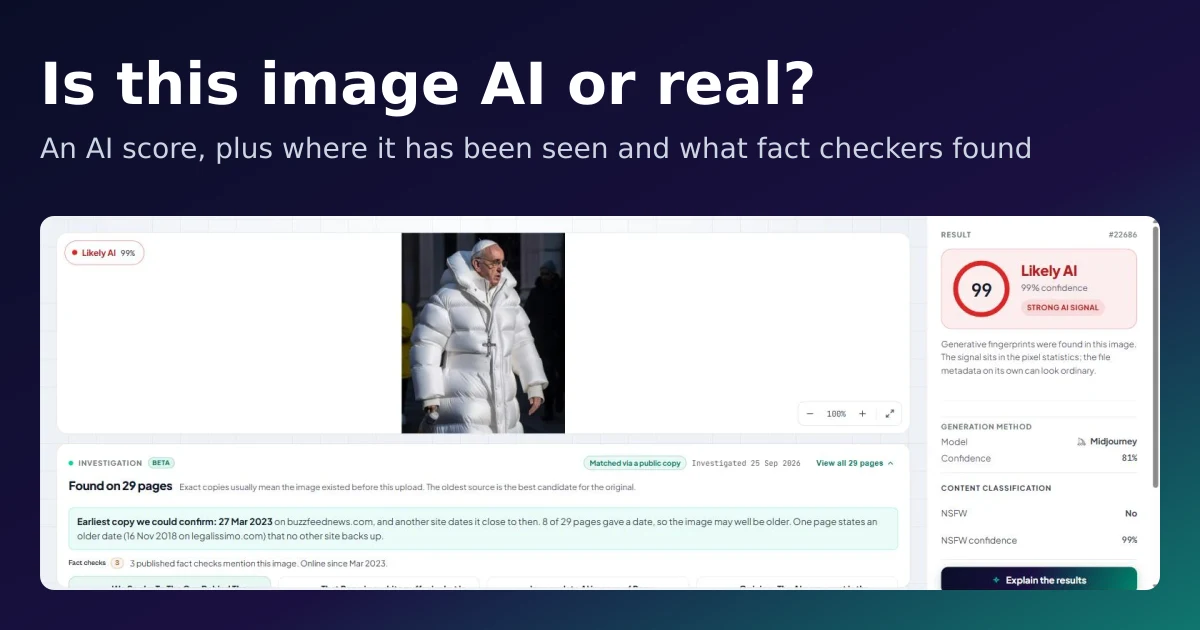
The Colorado State Fair controversy was just the beginning. As AI art tools mature, the boundaries between human and machine creativity will continue to blur, and the art world will have to adapt. If you're curious whether a particular image was human-made or AI-generated, try our AI Image Detector to find out in seconds.