
AI Detection
How to Detect AI-Generated Content: Images, Text, Video & Audio
A complete, plain-English guide to detecting AI-generated images, text, video, and audio, the manual tells, the tools, and a practical verification workflow.
AI-generated content is no longer easy to spot at a glance. Images, text, video, and audio produced by tools like Midjourney, GPT-5, Sora, and ElevenLabs now pass casual inspection every day. The good news: every medium leaves behind detectable patterns, and a mix of trained observation and detection tools can still tell you whether something was made by a machine.
This guide is the complete, plain-English overview of how to detect AI-generated content across all four media types. It links out to deeper guides for each one, so you can start here and go as deep as you need.
Key Takeaways
- No single signal is proof. Detection is about stacking evidence: visual artifacts, metadata, context, and a detector score together.
- Each medium has its own tells. Hands and text trip up image generators; uniform rhythm and "safe" phrasing flag AI text; unnatural blinking and lip-sync expose AI video.
- Detection tools give a probability, not a verdict. Treat a score as one input, combined with your own judgment.
- Context is the strongest free signal. Where the content came from, who posted it, and whether other sources corroborate it matter as much as the pixels.
Why AI Detection Matters Now
AI content sits behind a growing share of misinformation, romance and investment scams, fraudulent product listings, fake reviews, and academic dishonesty. As generators improve, the cost of being fooled rises, from a scam that drains a bank account to a fabricated news image that shapes public opinion. Building a habit of verification is now a basic digital-literacy skill, not a niche technical one.
How to Detect AI-Generated Images

An AI-generated image. Convincing at a glance, but the tells below give it away.
Images are the most common form of AI content people encounter. The fastest manual checks:
- Hands, teeth, and ears: extra fingers, fused digits, or asymmetric jewelry are classic giveaways.
- Text inside the image: signs, labels, and logos often render as malformed or nonsensical characters.
- Backgrounds: objects that melt together, impossible architecture, or repeating patterns.
- Skin and lighting: airbrushed, poreless skin and shadows that fall from impossible angles.
For a detailed walkthrough, read our guides on how to spot AI-generated images and AI vs real images: a visual guide for beginners. When you want an objective second opinion, run the file through our AI image detector.
How to Detect AI-Generated Art and Illustrations
AI art and digital illustrations follow slightly different rules than photographs. Brushwork that has no consistent logic, bizarrely smooth gradients, signatures that dissolve into noise, and styles that "average" several artists together are common signals. We cover this in depth in how to spot AI art, and the broader creative shift in the rise of AI art.
How to Detect AI-Generated Text
AI writing tends to be grammatically flawless but tonally flat. Watch for:
- Uniform sentence length and rhythm with little variation (low "burstiness").
- Hedging filler ("it is important to note," "in today's fast-paced world") and over-tidy structure.
- Confident statements with no specific sources, dates, or first-hand detail.
- Repeated transition phrases and a generic, committee-written voice.
Paste suspect writing into our AI text detector for a probability score, and remember that no text detector is conclusive, especially on short or lightly edited passages.
How to Detect AI-Generated Video and Deepfakes
Video is harder to fake convincingly, which makes the tells easier to catch once you know them: irregular or absent blinking, lips that drift out of sync with audio, flickering at the hairline or jaw, lighting that shifts between frames, and earrings or glasses that warp during motion. Our guide on detecting deepfake audio and video breaks down frame-by-frame techniques and the tools that help.
A Practical Verification Workflow
- Pause before you share. Most AI deception succeeds on emotion and speed.
- Inspect the media. Zoom in, check the medium-specific tells above.
- Check the source and context. Who posted it? Is it corroborated elsewhere? A reverse image search can surface the original.
- Run a detector. Use a tool matched to the medium for a probability score, not a final verdict.
- Weigh the evidence together. One weak signal means little; several pointing the same way is strong.
Choosing a tool? See our roundup of the best free AI detectors across images, text, and video.
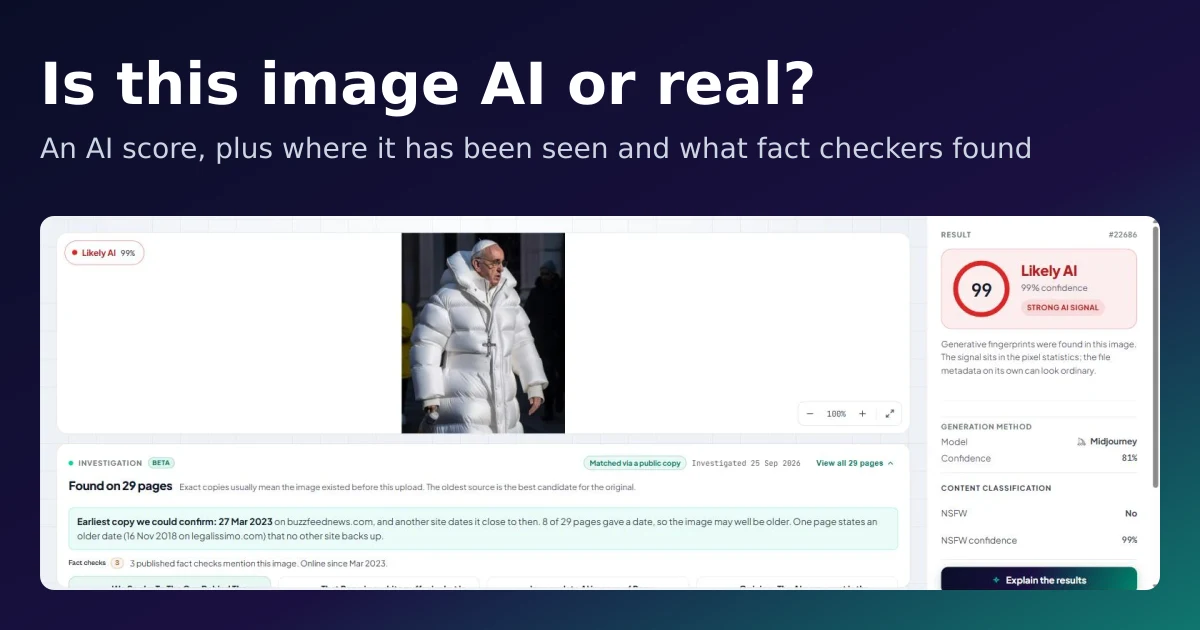
Check a photo yourself
Upload it to the detector. Investigate online shows where it has appeared before.
Frequently Asked Questions
Can AI-generated content be detected with 100% accuracy?
No. Detectors return a probability, and the best generators are designed to minimize tells. Combine tool scores with manual inspection and source-checking for the most reliable result.
What is the easiest sign that an image is AI-generated?
Malformed text and hands. If an image contains readable signage or visible fingers, examine them closely, generators still struggle with both.
Are AI text detectors reliable for short passages?
Less so. Short, generic, or heavily edited text gives detectors little signal, which raises both false positives and false negatives. Longer samples are more reliable.
Do detection tools store the files I upload?
It depends on the tool. Review each service's privacy policy; reputable detectors process content for analysis only and do not retain it.
AI detection is a moving target, but the fundamentals hold: look closely, question the source, and let a detection tool confirm your instinct rather than replace it. Start with the medium you encounter most, and bookmark this guide as your jumping-off point.
More from the blog

Try AI Image Detection Free
Upload any image and find out if it was generated by AI. Your first 3 checks need no account.