You found an image, and something about it feels off. Maybe it's a world leader somewhere they shouldn't be, or a disaster photo that seems too perfect. So you ask the obvious question: is this image AI or real? An AI score gives part of the answer. But a score can't tell you where the picture came from, how long it has been online, or whether anyone has already looked into it.
That missing context is what we built Investigate online for. It sits next to the AI check in the IsItAI.com AI image detector, and it adds what a number alone can't: where else the image has been seen, what fact checkers have said about it, and a plain-language explanation that pulls it all together.
Key Takeaways
- In 2025, Pew found 53% of U.S. adults aren't confident they can tell AI content from human-made content.
- In a study of about 135,000 fact checks, most image misinformation was real photos with a false caption, not AI images.
- Investigate online adds where an image has appeared, published fact checks and a written explanation.
- It's context to help you judge, not a certificate of authenticity.
Is This Image AI or Real? What a Score Leaves Out
In May 2024, a study of about 135,000 fact checks, AMMeBa: A Large-Scale Survey and Dataset of Media-Based Misinformation In-The-Wild, found that most image-based misinformation was context manipulation: a real photo given a false caption, place or date. An AI score can't catch that, because the photo itself is real.
Think about what that means. A genuine picture from a 2015 flood, reposted as "this morning's storm", passes any AI check with flying colors. The pixels are real. The story around them is not. The same study found AI-generated images were rare until spring 2023 and then rose sharply, so today you're facing both problems at once.
And people aren't great at spotting the difference by eye. In 2025, Microsoft's AI for Good Lab reported in How good are humans at detecting AI-generated images? that players of its "Real or Not" quiz were right only 62% of the time across about 287,000 judgements. That's only 12 points better than a coin flip. If you want to sharpen your own eye anyway, our guide on how to spot AI-generated images covers the visual clues, and our broader guide to detecting AI-generated content goes beyond images.
What Is Investigate Online?
In 2026, the Reuters Institute's Digital News Report 2026 found that 62% of people across 48 markets are concerned about what's real and fake online, up from 58% a year earlier. Investigate online is our answer to that worry: a switch in the detector that adds context to every check you run.
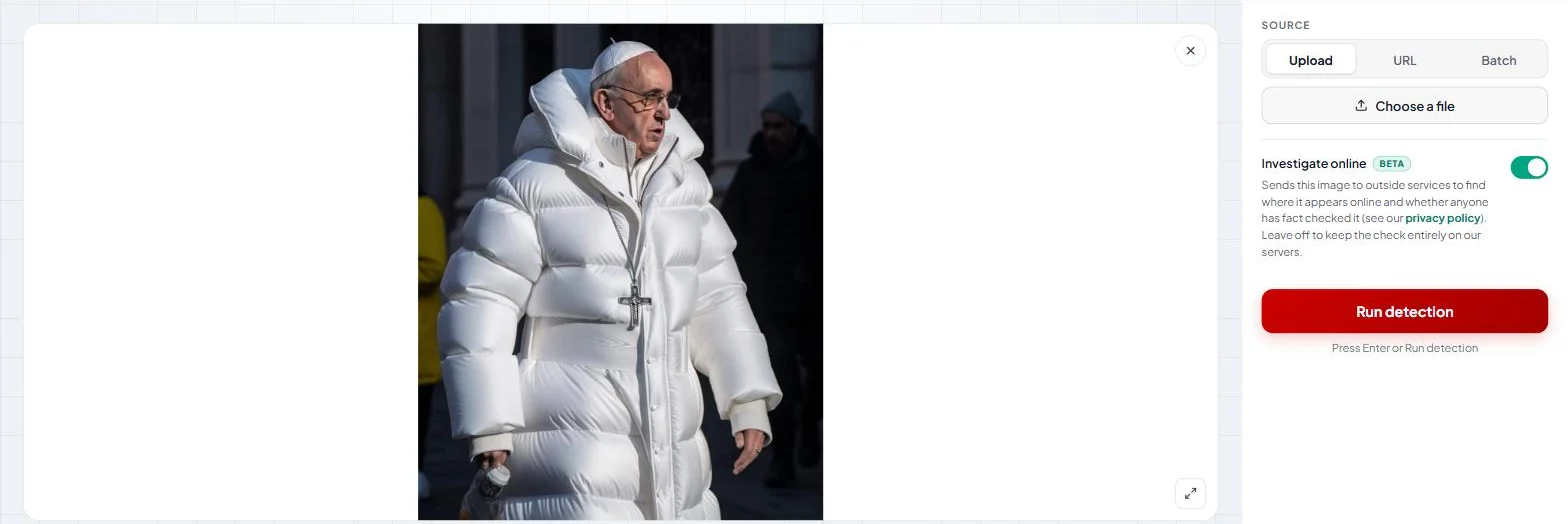
Here's how it works from your side:
- It's off by default. Nothing extra happens until you turn it on.
- It remembers your choice. Once on, it runs with every check until you switch it off.
- It runs alongside the AI check. You see the AI result first, and the online context fills in beside it.
- It's part of our paid plans. You can compare them on the plans page.
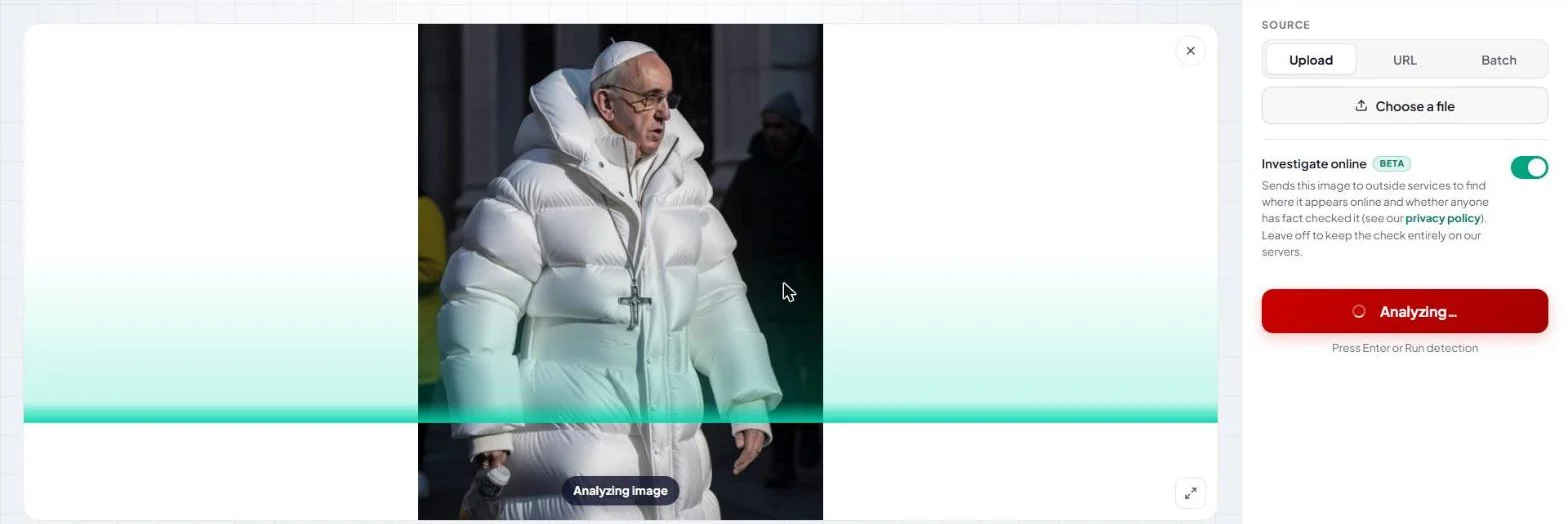
Why a switch rather than always on? Because some images are private. A photo of your kids, a document, a draft design: you may want an AI check on those without anything else happening. With the switch off, that's exactly what you get.
Where Has This Image Been Seen Before?
Stable Diffusion was released to the public on 22 August 2022, according to Stability AI's Stable Diffusion Public Release announcement. That date matters. A photo that several independent sites were already showing before then is unlikely to have come from the image generators most people use today.
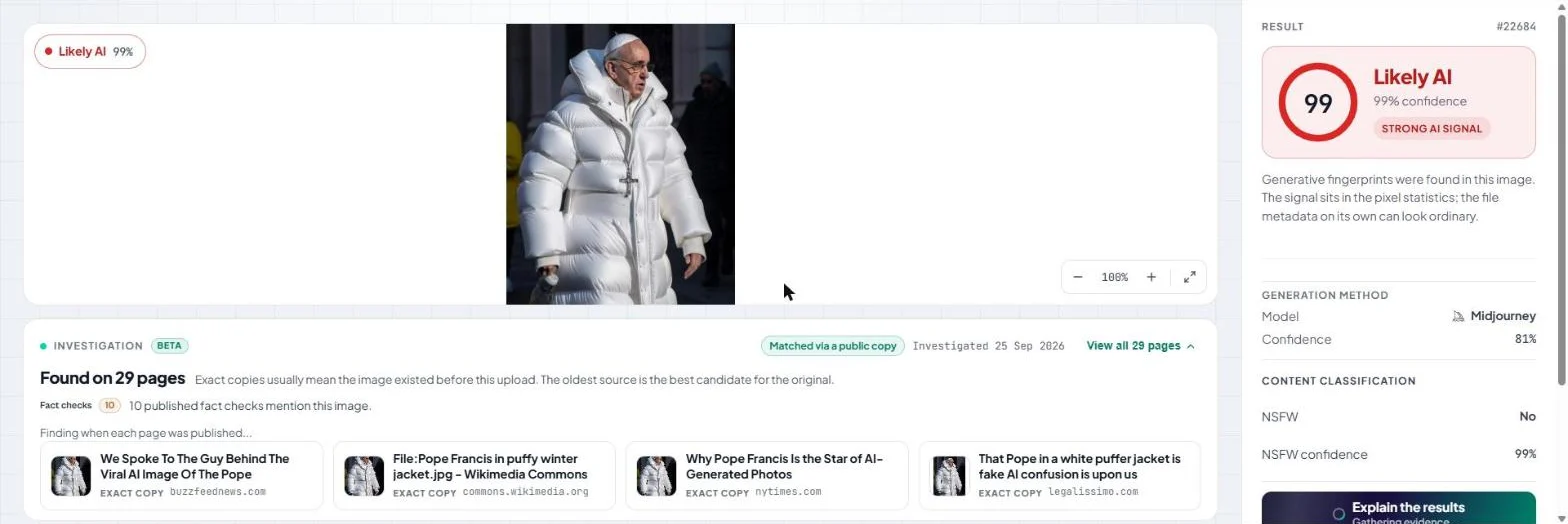
So the first thing Investigate online answers is: where else has this image appeared, and since when? You'll see how many pages show the same picture, which ones are exact copies and which are similar or cropped versions, and the earliest copy we could confirm.
Why "the earliest copy we could confirm"?
Because websites don't always tell the truth about dates. Some pages show a date that's wrong, from an old template or a backdated archive. If we simply took the oldest date on any page, one careless site could make a 2023 image look like it had been online since 2018.
We found exactly that while testing. So a date only counts as confirmed when a different website backs it up. If one page claims an older date that no other site supports, we still show it, but we tell you plainly that nobody else backs it up.

Has Anyone Fact Checked This Image?
As of June 2026, the Duke Reporters' Lab 2026 fact-checking census counted 437 active fact-checking projects in 116 countries and 70 languages. When a viral image makes the rounds, one of them may already have written about it. And people do look: the Reuters Institute's Digital News Report 2025 found 25% of people turn to fact checkers when they suspect something is false.
Investigate online surfaces those published fact checks next to your result. Each card shows the fact checker's own rating (in their own language, such as "Altered" or "Yanlış"), the claim they checked, the date, and a link to read the full article.
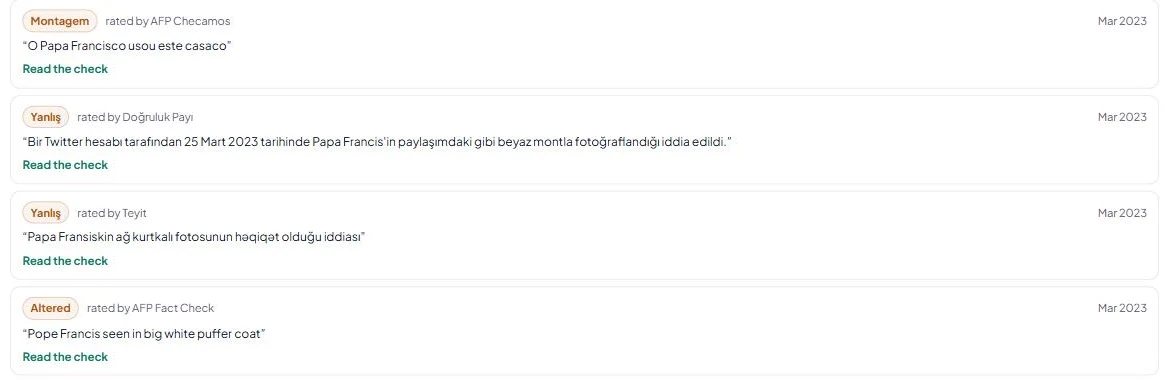
We don't rewrite their verdicts. A fact checker has done the reporting, so you should read their reasoning in their words. Our job is to put that work in front of you at the moment you need it.
How Does "Explain the Results" Pull It Together?
A score, a list of pages and a set of fact checks is a lot to weigh up. That's what Explain the results is for. And telling the difference matters to people: in 2025, Pew Research Center's How Americans View AI and Its Impact on People and Society found 76% of U.S. adults say it's extremely or very important to be able to tell AI content from human-made content.
Once the online context has come in, one click writes a short, plain-language explanation. We call it the multimodal explanation, because it looks at the image itself together with everything gathered about it: the AI signal, the earliest copies and what fact checkers said.
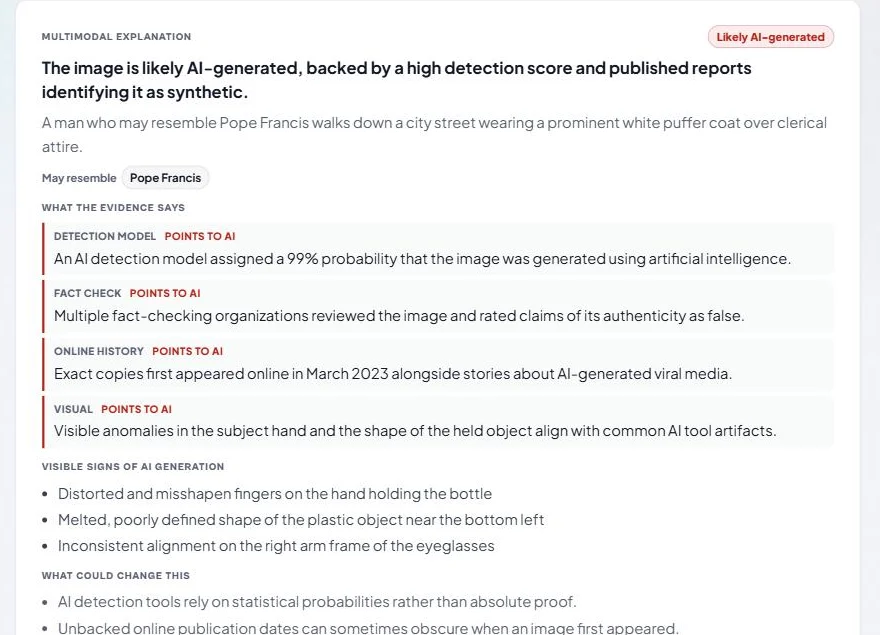
A few rules shape how it's written:
- It never claims certainty. It says "likely", not "proven".
- It doesn't name people as fact. If a face looks like someone famous, it says the image "may resemble" them.
- It compares copies. When an earlier version exists online, it points out what changed, such as a swapped background or an added face.
- It lists AI tell-tales only when the verdict is AI. A real photo doesn't get a list of made-up flaws.
That last point matters for edited photos. A real picture with one face pasted in isn't "AI-generated", and it isn't untouched either. Comparing it with an earlier copy is often the clearest way to see what happened.
A Real Example: The Pope in a Puffer Jacket
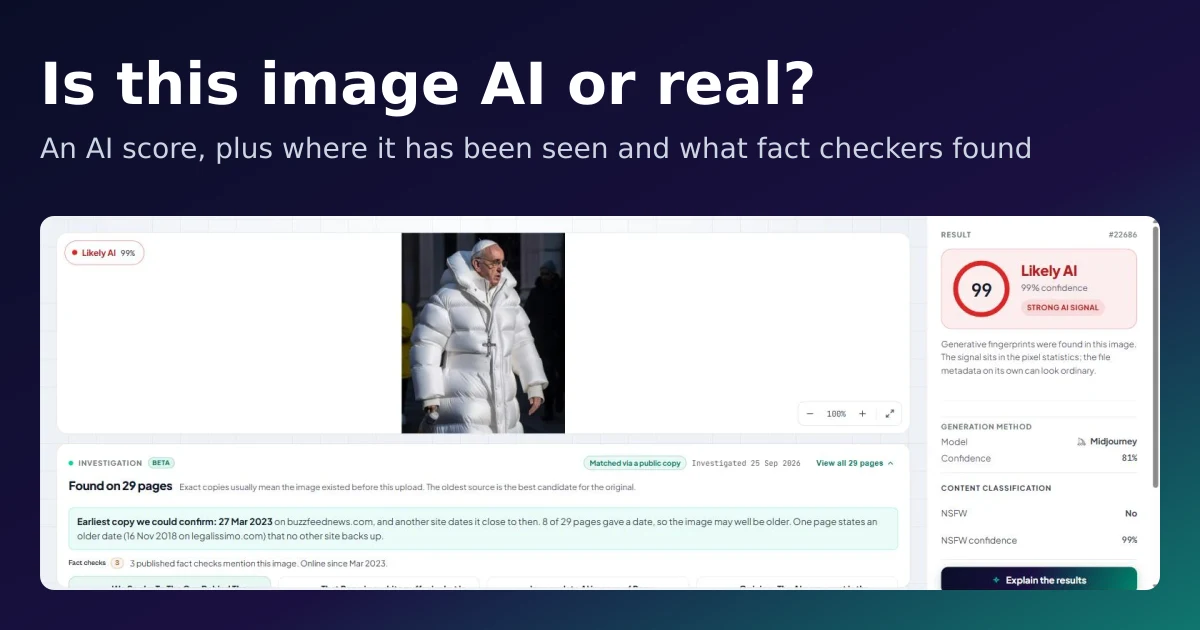
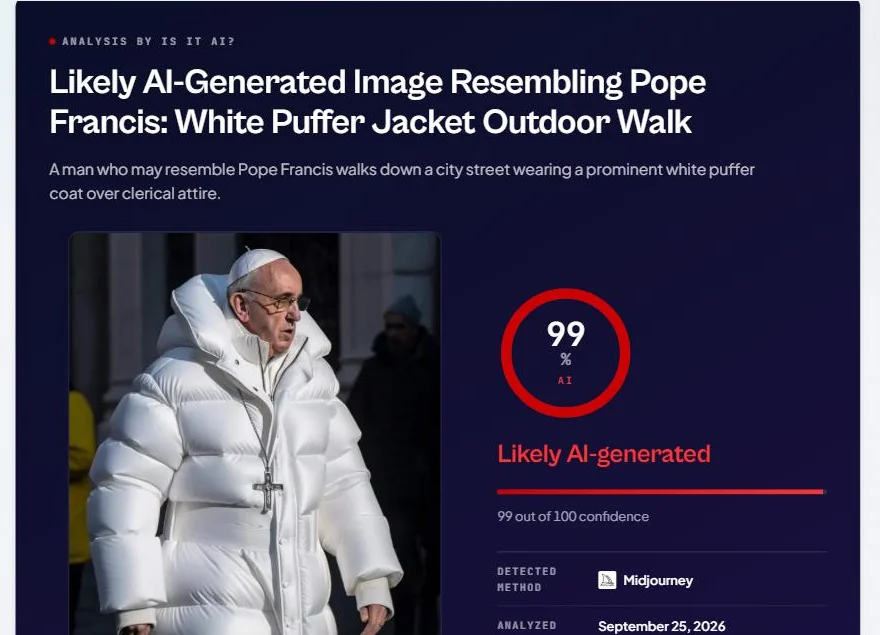
In March 2023, an image of Pope Francis in a long white puffer jacket went viral. BuzzFeed News later interviewed its creator, who made it with Midjourney. It's one of the most widely covered AI images, so we ran it through the detector with Investigate online on.
Here's what came back:
- AI check: Likely AI at 99%, with Midjourney as the likely generation method.
- Seen before: found on 29 pages. The earliest copy we could confirm was on 27 March 2023, on buzzfeednews.com. That's the earliest date a second site backs up, not necessarily the first moment it was posted; the image spread on social media a few days earlier.
- A date we didn't trust: one page claimed the image was online in November 2018. No other site backed that up, so we flagged it rather than trusting it.
- Fact checks: 10 published fact checks, from AFP, Full Fact, Teyit, Doğruluk Payı and others.
The 2018 date shows why the confirmation rule exists. Without the confirmation rule, a single backdated page would have suggested the image existed years before AI image generators. Every signal pointed the same way here, and the result reads as a clear, well-supported "likely AI".
You can also share the result as a public page. The title leads with the reading and hedges any names, so it says "Likely AI-Generated Image Resembling Pope Francis" instead of claiming the photo shows him.
What Stays Private?
Some images you check are personal, so here's exactly what happens to them:
- With Investigate online off, nothing from your checks is sent anywhere for this feature.
- With it on, the image and text taken from it go to the service providers we use to find where it appears and whether it has been fact checked.
- Results stay in your history with that check, until you delete it.
- Nothing is public unless you share it. A shared result page is a choice you make, per check.
The full details are in our privacy policy.
Context, Not a Verdict From Above
We want to be clear about what this is. Is It AI? isn't an authority that stamps images "real" or "fake". No tool can honestly promise that, and Microsoft's 62% human accuracy figure is a reminder that our eyes can't either. What we can do is put the useful context in one place, quickly, so your own judgment has more to work with.
Sometimes that context is decisive: ten fact checks and a confirmed 2023 first appearance. Sometimes it's thin: a brand new image with no history online. Both are useful to know. For more on judging what you see, read our visual guide to AI vs real images or our look at detecting deepfake audio and video.
Try it on the next image that makes you pause. Open the AI image detector, turn on Investigate online, and see what the image's history says the next time you wonder: is this image AI or real?
Frequently Asked Questions
Is this image AI or real? How can I tell?
Start with an AI image checker for a probability score, then look at context. Where did the image first appear, and has anyone fact checked it? In a 2025 Microsoft study, people were right only 62% of the time by eye, so it helps to add a score and the image's history rather than rely on looking alone.
Where did this image come from?
Turn on Investigate online in the IsItAI.com detector. It shows pages where the same or similar image appears and the earliest copy that a second site backs up. Since Stable Diffusion went public on 22 August 2022, a confirmed copy older than that is useful context that the image probably predates today's popular generators.
Has this photo been fact checked?
Investigate online shows published fact checks that mention the image, with the fact checker's own rating and a link to the full article. The Duke Reporters' Lab counted 437 active fact-checking projects in 2026, so a widely shared image may already have been checked. We don't rewrite their verdicts; you read them in their words.
Does Investigate online prove an image is real?
No. It adds context, not a certificate. AMMeBa's 2024 study found most image misinformation uses real photos with false captions, so even a real image can mislead. Our explanation always hedges ("likely", "may resemble") and shows the evidence, so you can weigh it yourself.
Is my image shared publicly when I use it?
No. Results stay in your history until you delete it, and a public page only exists if you choose to share a check. With the switch off, nothing from your checks is sent for this feature. Checking an image should never mean giving it away.
Sources
- Reuters Institute, Digital News Report 2026, executive summary, retrieved 2026-09-24, reutersinstitute.politics.ox.ac.uk
- Reuters Institute, Digital News Report 2025, executive summary, retrieved 2026-09-24, reutersinstitute.politics.ox.ac.uk
- Pew Research Center, How Americans View AI and Its Impact on People and Society, 17 Sep 2025, retrieved 2026-09-24, pewresearch.org
- Ofcom, A deep dive into deepfakes that demean, defraud and disinform, Jul 2024, retrieved 2026-09-24, ofcom.org.uk
- Dufour et al., AMMeBa: A Large-Scale Survey and Dataset of Media-Based Misinformation In-The-Wild, arXiv:2405.11697, May 2024, retrieved 2026-09-24, arxiv.org
- Roca et al., How good are humans at detecting AI-generated images? Learnings from an experiment, arXiv:2507.18640, 2025, retrieved 2026-09-24, arxiv.org
- Duke Reporters' Lab, 2026 census: Fact-checking losses continue amid funding pressure, but most projects persist, 12 Jun 2026, retrieved 2026-09-24, reporterslab.org
- Stability AI, Stable Diffusion Public Release, 22 Aug 2022, retrieved 2026-09-24, stability.ai
- GIGAZINE, Midjourney v4, 10 Nov 2022, retrieved 2026-09-24, gigazine.net
- Image: "Pope Francis in puffy winter jacket", made with Midjourney (2023), public domain via Wikimedia Commons