
AI Detection
Can You Tell Which Images Are AI? Try These Tests
Most people can't reliably tell AI images from real photos. See what the studies found, then test yourself on four real and AI landscapes.
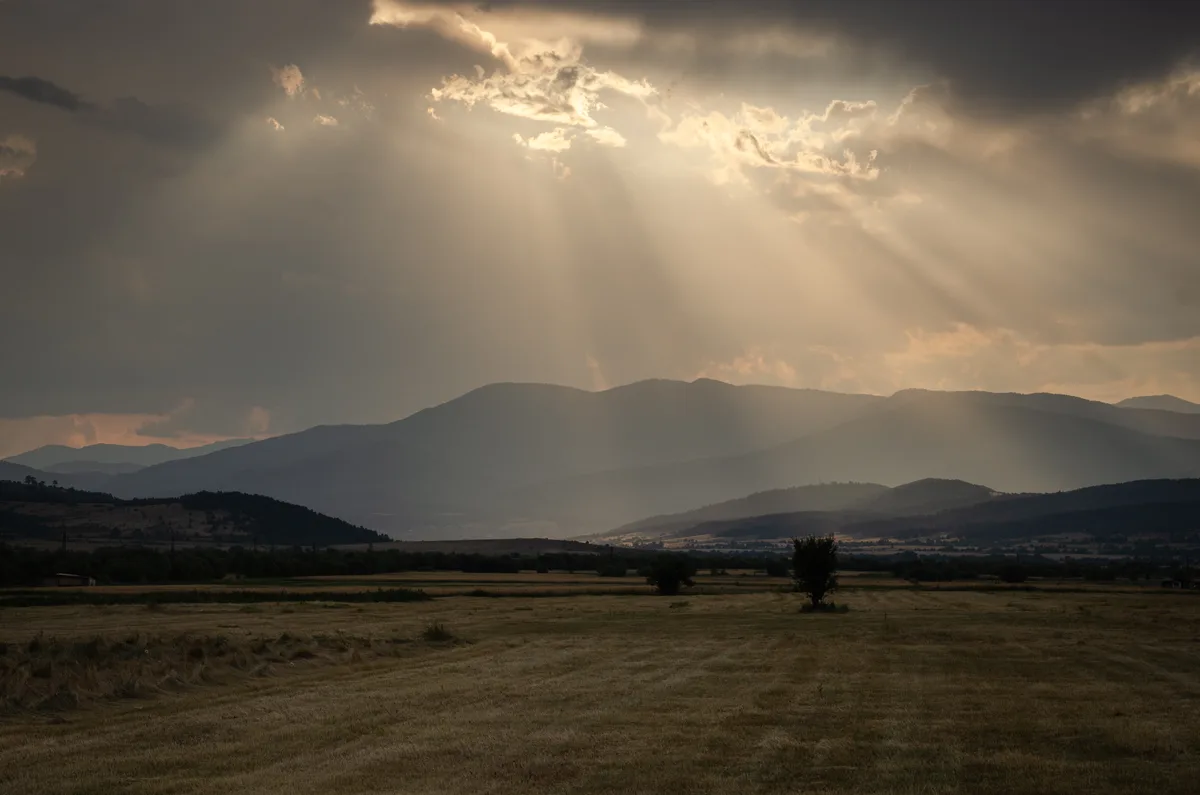
Can you tell which images are AI-generated? Not reliably. In a 2025 Microsoft Research study of the Real or Not quiz, more than 12,500 people were right only 62% of the time, and an earlier study of faces found people did about as well as a coin flip.
Below you'll find what the research says about who gets fooled and why, a four-image AI or real quiz you can try right now, where to find more tests, and what works better than guessing when an image really matters.
Key Takeaways
- In Microsoft's 2025 study, people judged about 287,000 images and were right only 62% of the time.
- A 2022 study of faces found people were right 48.2% of the time, close to a coin flip.
- Landscapes fooled people more than portraits, and some AI faces looked more human than real ones.
- Training helped a little in two studies, and in one of them most of the gain came from recognising real photos.
- When an image matters, check where it first appeared and who posted it instead of trusting your eye.
Can You Tell Which Images Are AI? What the Studies Found
The biggest test so far comes from Microsoft Research. In How good are humans at detecting AI-generated images? (2025), the researchers analysed about 287,000 image judgements from more than 12,500 people around the world who played the Real or Not quiz. The overall success rate was 62%. For the AI images alone, it was 63%.
The authors add that their results "likely overestimate" how good people are at this today.
Faces tell a similar story. In a 2022 study in the journal PNAS, AI-synthesized faces are indistinguishable from real faces and more trustworthy, Nightingale and Farid found an average accuracy of 48.2%, which they called "close to chance performance of 50%".
A survey across three countries pointed the same way. In A Representative Study on Human Detection of Artificially Generated Media Across Countries, presented at the Security and Privacy 2024 conference, 3,002 people in the USA, Germany and China judged audio, images and text. The authors found the best fakes were almost indistinguishable from real media, "with the majority of participants simply guessing".
Are People Better at Spotting AI Portraits?
One newer study is more upbeat. A 2026 preprint by Kim and colleagues, Human Factors in Detecting AI-Generated Portraits, reports a mean accuracy of 85.2% on portraits. It's a preprint, and portraits were the easiest type of image in Microsoft's data.
Even there, accuracy fell with age, people on phones scored 3.65 points lower than people on computers, and portraits made with ChatGPT-4o were harder to judge than those from the other generator tested.
Can You Spot the AI in These Four Images?
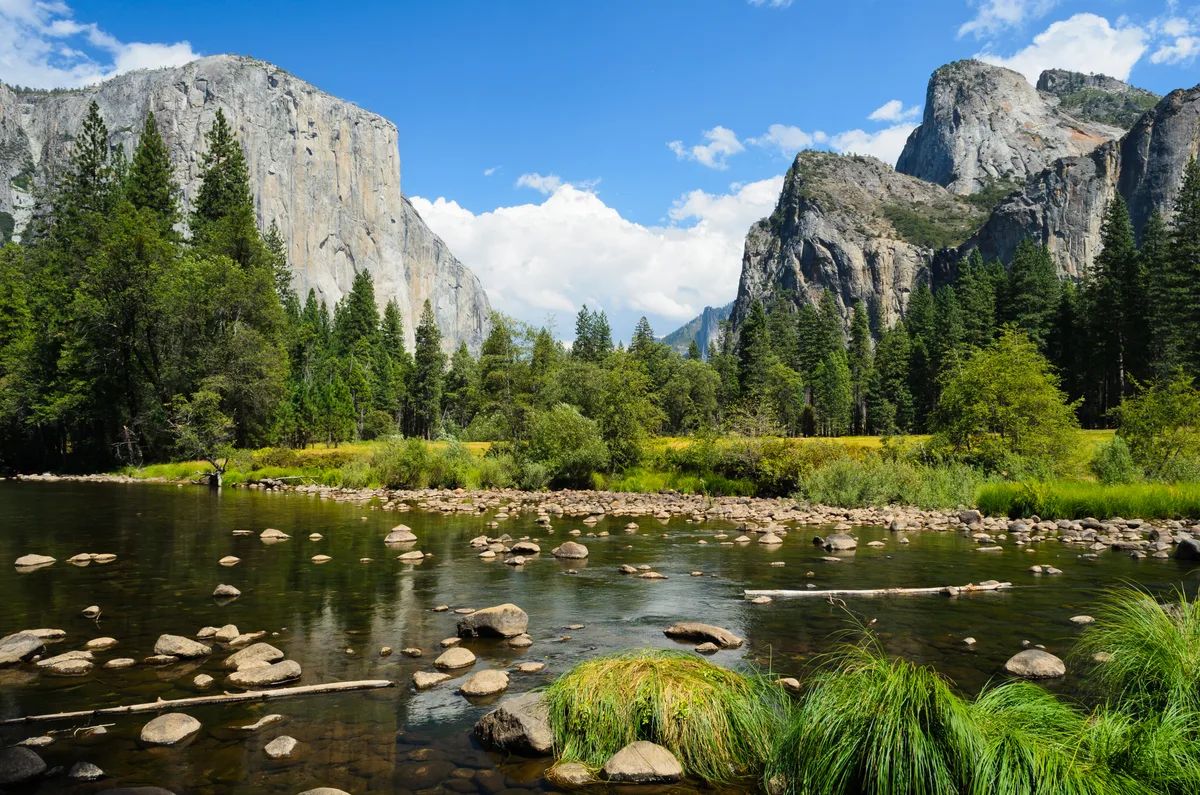
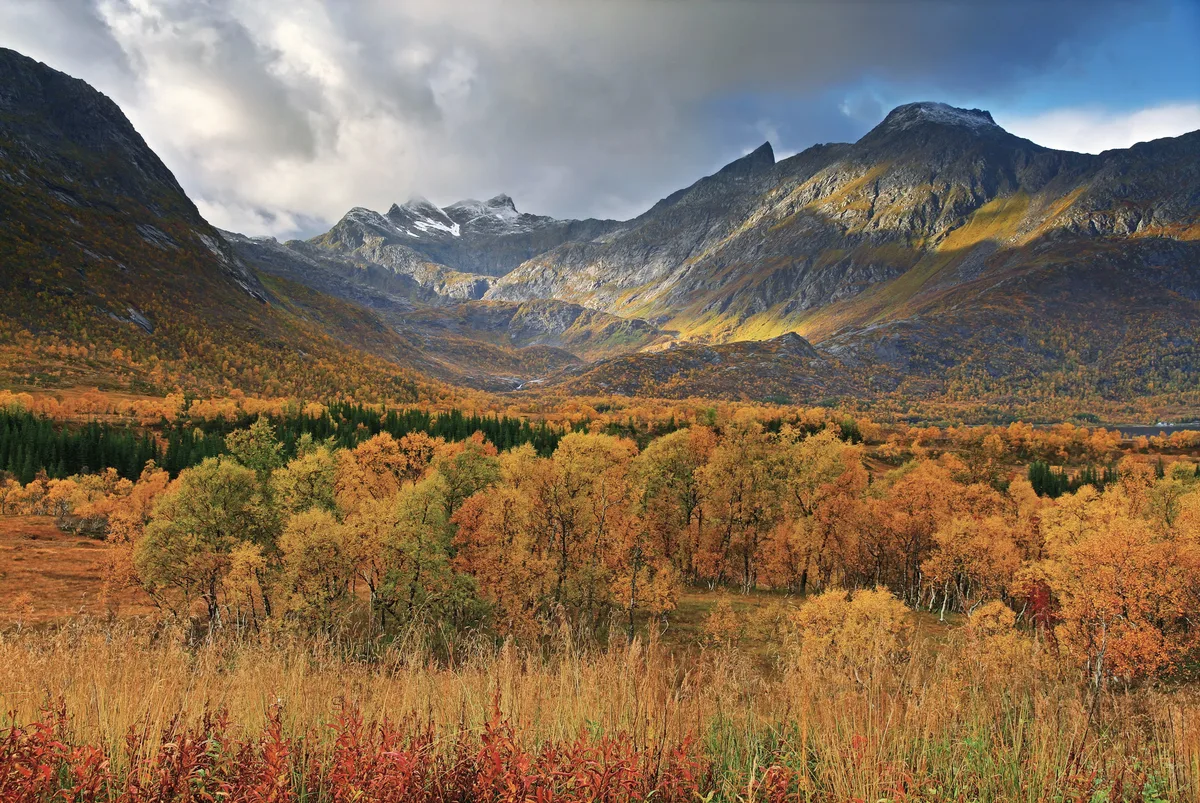
Microsoft's players were most accurate with portraits and "struggled significantly with natural and urban landscapes". So here are four landscapes. Some are camera photos and some came out of an AI image generator. Decide on each one before you open its answer.
All four come from Wikimedia Commons, where each file page records how the image was made. We only resized and cropped them.

Show the answer for image 1
AI-generated. Its Commons file page says it was "Generated with NightCafe Studio in Stable Diffusion 1.5 mode." This is the warm-up, made with an older model. To our eyes it looks painted rather than photographed: smooth colour blends, little fine detail in the trees, and a loose, blurry reflection in the lake.
Show the answer for image 2
A real photo. It shows Valley View in Yosemite National Park, taken in August 2013 with a Nikon D5100, according to its Commons file page. It's full of small, uneven detail: rocks of every size scattered at random, a fallen log, grass that's sharp in some places and soft in others. To our eyes that reads as a camera photo, though AI images can include that kind of detail too.
Two Harder Ones
Show the answer for image 3
A real photo. It's an autumn view near Gullesfjordbotn on the island of Hinnøya in Norway, taken in September 2010 with a Canon EOS 7D, says its Commons file page. The colours are strong, which to us makes it easy to doubt. In the analyst study below, most of what training improved was people's accuracy on real photos.

Show the answer for image 4
AI-generated. Its Commons file page says it was made with the FLUX.1 Pro model in NightCafe Studio. It's far more convincing than image 1. The clues we noticed are soft ones: a glow that lights everything evenly, boulders that look smooth and alike, and a cabin with little detail. None of these proves anything on its own, and a real river photo could share some of them.
How Did You Do?
Four images is a tiny sample. Pure guessing gets all four right 1 time in 16, and three or more right about 1 time in 3, so a good score here proves little. Clues may also look more obvious once you know the answer.
Where Can You Take an AI or Real Image Quiz?
More tests to try:
- Which Face Is Real. Which Face Is Real, built by Jevin West and Carl Bergstrom at the University of Washington, shows two faces and asks you to "Click on the person who is real." The fake faces come from StyleGAN, and the real ones are Creative Commons and public domain photos. The site's copyright line says 2019.
- Microsoft's Real or Not. The quiz behind the 62% figure shows "one image at a time, for 15 rounds", according to the Microsoft Research paper, and draws on a random sample of real and AI-generated images.
If you're judging drawings and paintings rather than photos, our guide on how to tell if art is AI covers the signs to look for.
Why Do People Get Fooled by AI Images?
The problem isn't only that AI images look real. Some AI faces even look more human than real ones. In a study published in Psychological Science, 124 White adults each judged 50 AI faces and 50 human faces, as the British Psychological Society's Research Digest reported in December 2023. The five faces most often judged human were all AI-generated.
The same report says the people who did worst at spotting AI faces "had the poorest insight into their abilities". So the people making the most mistakes were also the least aware of how they were doing.
Trust plays a part too. In the 2022 PNAS study, people rated AI faces 4.82 for trustworthiness on average, against 4.48 for real faces. The authors call that "only 7.7% more trustworthy", but it still means the fakes came out ahead. And in the three-country study, AI-generated media was rated more human-like across every media type and every country.
That study also found that a person's general trust, their habit of stopping to think, and how familiar they felt with deepfakes all shaped their answers.
Does Practice Help You Spot AI Images?
A little, but less than you might hope. In the PNAS study, people who were told about common rendering flaws and got feedback scored 59.0%. That beats the 48.2% of the untrained group, but the authors wrote that "overall performance remained only slightly above chance". And being told after every answer whether they were right didn't make people better as they went: "Despite providing trial-by-trial feedback, there was no improvement in accuracy over time".
A forthcoming 2026 study from the Kellogg School of Management tested intelligence analysts employed by the United States government. Before training they were right 72% of the time. Training "increased overall accuracy by 9 percentage points", and the gain was "driven by a 14.2 percentage point increase in accuracy for real images".
So most of the gain came from real images: the analysts got better at recognising real photos as real. And a photo that looks a bit off isn't always AI-generated, which is why our guide on how to tell if a photo was edited with AI is worth a read.
How Can You Check an Image Instead of Guessing?
Since our eyes are unreliable, the European Digital Media Observatory's tips for detecting AI-generated content start somewhere else: try "to find the origin of the image, i.e. when and where it appeared online for the first time." It also says to check the source for warning signs, and to use detection tools without relying on them alone.
Here's a simple routine for any image that matters to you:
- Ask who posted it first. A named photographer or a news agency is a better sign than an account that only shares viral pictures.
- Look for the original. Older, larger or uncropped copies often show where the picture came from.
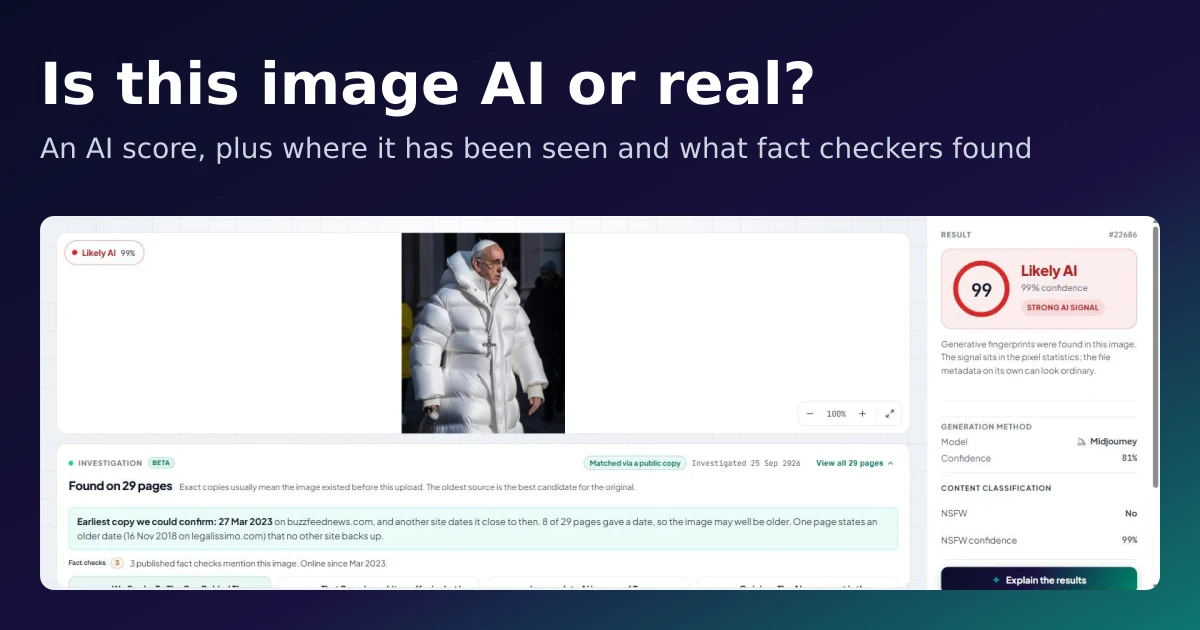
- Run a check. The IsItAI.com AI image detector gives you a probability, not a promise, so treat it as one more clue.
- Search for a fact-check. If the image went viral, someone may have looked into it already.
For more on reading the context around an image, see is this image AI or real. And if you're also dealing with text, video or audio, our guide to detecting AI-generated content covers each of them.
Check a photo yourself
Upload it to the detector. Investigate online shows where it has appeared before.
Frequently Asked Questions
Can most people tell if an image is AI-generated?
Not reliably. In a 2025 Microsoft Research study of about 287,000 judgements, people were right 62% of the time, and a 2022 study of faces found 48.2%, close to a coin flip. A 2026 preprint found higher scores for portraits, but portraits are the easiest kind of image to judge, and one of the two generators tested was harder to judge than the other.
Which AI images are hardest to spot?
In Microsoft's Real or Not study, people were most accurate with portraits and struggled most with natural and urban landscapes. A 2026 preprint also found portraits made with ChatGPT-4o harder to judge than those from another generator. Faces can fool people too: in one study, the five faces most often judged human were all AI-generated.
Can you train yourself to spot AI images?
A little. In a 2022 study, people who learned about common flaws and got feedback scored 59.0%, while a separate untrained group scored 48.2%, so still only slightly above chance. In a 2026 study of intelligence analysts, training added 9 points, mostly on real photos. Practice helps, but it won't make you certain.
Is there a quiz to test if I can spot AI images?
Yes. Which Face Is Real, made at the University of Washington, shows two faces and asks you to click the real one. Microsoft's Real or Not quiz, used in its 2025 study, shows one image at a time for 15 rounds. This post also has a four-image landscape test with answers you can reveal.
Sources
- Roca and others, How good are humans at detecting AI-generated images? Learnings from an experiment, arXiv:2507.18640, 2025, retrieved 2026-10-27, arxiv.org
- Microsoft Research, publication page for How good are humans at detecting AI-generated images?, June 2025, retrieved 2026-10-27, microsoft.com
- Nightingale and Farid, AI-synthesized faces are indistinguishable from real faces and more trustworthy, PNAS, 14 Feb 2022, retrieved 2026-10-27, pmc.ncbi.nlm.nih.gov
- Frank and others, A Representative Study on Human Detection of Artificially Generated Media Across Countries, arXiv:2312.05976, Dec 2023, retrieved 2026-10-27, arxiv.org
and 5 more
- Kim and others, Human Factors in Detecting AI-Generated Portraits: Age, Sex, Device, and Confidence, arXiv:2603.24048 (preprint), 2026, retrieved 2026-10-27, arxiv.org
- British Psychological Society Research Digest, AI faces seem realer than real, 12 Dec 2023, retrieved 2026-10-27, bps.org.uk
- Kamali, Gerstner, Hullman and Groh, Kellogg School of Management, Generative AI literacy training improves intelligence analysts' discrimination of real and AI-generated images, forthcoming 2026, retrieved 2026-10-27, kellogg.northwestern.edu
- Jevin West and Carl Bergstrom, University of Washington, Which Face Is Real, retrieved 2026-10-27, whichfaceisreal.com
- European Digital Media Observatory, Tips for Users to Detect AI-Generated Content, 5 Apr 2024, retrieved 2026-10-27, edmo.eu
Featured photo: Chepino Valley Landscape, Nannoyani, CC0, via Wikimedia Commons.
More from the blog

Try AI Image Detection Free
Upload any image and find out if it was generated by AI. Your first 3 checks need no account.